
Attracting new patients and growing a practice consistently can be tough for many dentists. They deal with everything from local competition and big dental chains to a few referrals and little online presence.
Dental SEO (Search Engine Optimization) is a beneficial strategy for dental practices. It’s important to note that SEO is not simply a fix for existing problems, but also a proactive solution that should be implemented from the beginning.
Meaning, there’s no need to wait to fall behind competitors before prioritizing SEO.
In this article, we’ll cover everything you need to know about dental SEO, including its importance and ways to implement it.
What is Dental SEO?
Dental SEO is a specialized strategy that focuses on optimizing a dental practice’s online presence so that it ranks higher in search engines like Google when patients search for relevant queries.
Key techniques used in dental SEO include:
- Keyword research: Identifying the terms and phrases potential patients use when looking for dental services in the local area.
- Website optimization: Enhancing site structure and creating high-quality, informative content that answers common patient questions and delivers a positive user experience.
- Performance tracking: Monitoring search rankings and adjusting SEO strategies based on data and performance metrics.
Why is SEO for Dentists Important?
Most potential patients turn to search engines as their main way to find local services. For instance, terms like “dentist near me” are among the most commonly searched when people are looking for dental care in the United States, according to Ahrefs’ Keyword Explorer.
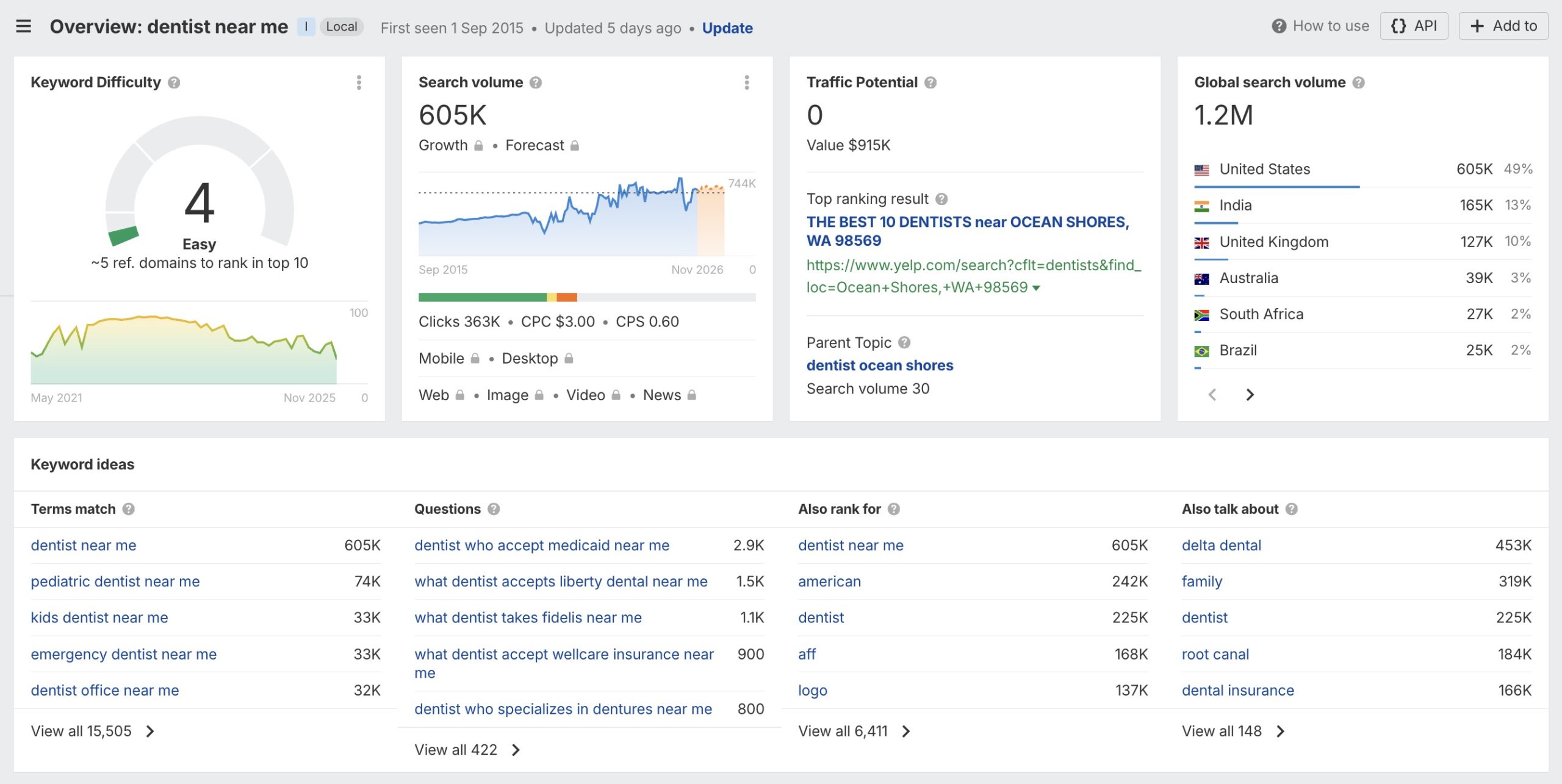
Optimizing for SEO can ensure that your dental practice appears in these search results, which leads to more visitors to your website), better patient acquisition and increased appointment bookings, and an enhanced local presence.
As potential patients search for relevant keywords, seeing your website at the top helps establish credibility and trust in your business. The result is greater long-term growth.
How to Do Dental SEO
Keep in mind that implementing dental SEO is a continuous process. It requires consistent attention and effort, especially since search engines evolve.
Moreover, your dental business can start small and gradually build on your efforts — and you may also hire an expert to implement a well-rounded strategy.
Here are the SEO steps involved to boost your visibility and gain a competitive advantage:
1. Claim and optimize your dental practice on Google My Business
Google My Business (GMB) is a free tool provided by Google that allows businesses to create and manage their online presence across Google, including Search and Maps.
By creating a GMB listing, dental practices can control the information that appears when people search for them online, such as:
- Business name
- Address
- Phone number
- Hours of operation
- Customer reviews
Claiming and optimizing a GMB listing can improve your practice’s visibility in local search results. This will ensure that your practice appears prominently.
2. List your dental practice on reputable online directories
Online directories are digital platforms that compile and organize information about businesses into categorized lists. These directories serve as a modern-day version of the Yellow Pages, and each listing includes essential details about your business.
Many directories have high domain authority, meaning they rank well in search engine results, which can drive more traffic to your practice.
Being listed on reputable directories can also improve your practice’s online visibility and credibility, which makes it easier for potential patients to find and choose your dental services.
3. Identify relevant keywords patients might use when searching for dental services
Identifying relevant keywords that patients might use when searching for dental services is like speaking the same language as your potential patients online.
When you understand the words and phrases people commonly use when looking for a dentist, you can tailor your website content and online presence to match those search queries.
For example, if someone in your area searches for “teeth cleaning near me” or “family dentist in [your city],” and you’ve optimized your website with those keywords, your practice is more likely to appear in their search results.
In essence, identifying relevant keywords is like putting up a sign that communicates your business has what customers are looking for.
4. Optimize your dental website’s pages
Optimizing your dental website’s pages means making it easy for both search engines and potential patients to find and use your site. Key strategies include:
- Using relevant keywords in your page titles, headings, and content to match what patients are searching for.
- Improving page speed so your site loads quickly.
- Simplifying navigation on both mobile devices and desktops.
- Enhancing user experience by providing clear, helpful content and a visually appealing layout.
The first step to optimizing pages is conducting a website audit, which an SEO professional can help you with. This audit helps to identify areas for improvement in various aspects, such as content, technical setup, and user experience.
5. Publish high-quality content related to dentistry
Speaking of content, search engines prioritize websites that consistently provide valuable, relevant content. This kind of content helps your website rank higher in search results.
So, what does high-quality dental content look like? It is:
- Informative and educational – answers common patient questions and explains procedures clearly.
- Patient-focused – tailored to your audience’s needs and concerns.
- Locally optimized – includes relevant local keywords to attract patients in your area.
- Accurate and well-researched – based on up-to-date dental knowledge and best practices.
- Engaging and easy to read – uses clear language and a reader-friendly format.
- Interlinked – connects to other relevant pages on your site to improve navigation and SEO.
You can create different types of content on your dental website, such as blog posts, service pages, a comprehensive FAQ section, patient guides, and case studies or testimonials.
6. Build backlinks from reputable dental websites
Backlinks, also known as inbound or incoming links, are hyperlinks from one website to a page on another website. They are important for SEO because search engines like Google view them as indicators of a website’s authority, credibility, and relevance.
Essentially, backlinks act as “votes of confidence” from one site to another. The more high-quality backlinks a website has, the more likely it is to rank higher in SERPs.
Here are examples of backlinks for a dental website:
- An article about dental health on a reputable health website that links to your site for more detailed information on a specific dental procedure.
- Writing a guest blog post for a popular dental blog or a health and wellness blog, where your author bio includes a link back to your dental practice’s website.
- A local news website covers a story about a community event sponsored by your dental practice and includes a link to your website in the article.
- A dental school or local college includes a link to your site on their resource page for students and the community.
When building or acquiring backlinks for your dental website, always remember to produce content that others will want to link to and share.
7. Encourage dental patients to leave reviews
Genuine reviews from real patients provide authentic feedback about your dental practice. Potential patients trust the experiences of others and are more likely to believe these reviews over promotional content from the business itself.
Moreover, reviews demonstrate that your practice is open to feedback, which can be reassuring to potential patients. They highlight the strengths of your practice, such as friendly staff, comfortable facilities, and successful treatments.
As potential patients read them, they become convinced to choose your practice over competitors.
When it comes to local SEO, the number of your reviews (quantity) and their average rating (quality) can positively influence your dental practice’s local ranking.
8. Regularly monitor your dental website’s performance
Building a website is just the beginning of your online presence. To ensure it remains effective and competitive, especially in terms of SEO, you need to regularly monitor and optimize its performance.
Remember that SEO is dynamic — what works today might not work tomorrow. Competitors are also optimizing their websites to improve their SEO. If they implement more effective strategies, they can overtake you in search rankings.
Moreover, patient behavior and preferences change over time. What your patients find engaging or useful today might change tomorrow.
Here are some ways to keep your dental website optimized:
- Regularly update content with new blog posts, guides, or FAQs to reflect current patient needs and trends.
- Monitor website performance using analytics tools to track page speed, bounce rates, and visitor behavior.
- Check and update SEO keywords to match changing search trends in your local area.
- Audit backlinks and internal links.
- Review user experience (UX) on both desktop and mobile devices to keep navigation intuitive and content easy to find.
- Stay informed about SEO best practices and algorithm updates from Google.
Keeping up with these trends is vital for maintaining a user-friendly website.
Summary
SEO is a must for dental practices looking to attract more patients, increase visibility, and build credibility online. It helps your practice stand out and compete effectively with other local dental offices.
The strategies outlined above can help your practice achieve several key advantages, including a steady growth in your patient base and long-term success.
Don’t let competitors take the lead. Contact our Las Vegas SEO team today and start attracting more patients.